

Every time a user is redirected to a third-party domain during onboarding, your brand equity bleeds out. Trust is fragile; a sudden shift in visual identity during a high-stakes KYC process suggests a lack of structural integrity. You understand that high-friction onboarding leads to user drop-off, yet building a proprietary compliance stack from scratch is a resource-intensive burden. Implementing white label identity verification isn't just a cosmetic upgrade. It's the strategic embedding of financial intelligence into your brand DNA.
This guide provides a blueprint for mastering the architectural and regulatory requirements of a fully branded ecosystem. You'll learn how the ORCRUX Platform enables you to deploy a seamless user journey that satisfies AML and KYB mandates without sacrificing your aesthetic. We'll examine how automated UBO mapping and sanctions screening reduce manual review time, allowing you to scale with composed assurance. By the end, you'll have the framework to transform compliance from a bottleneck into a competitive advantage.
Key Takeaways
- Resolve the Trust Paradox by maintaining brand continuity throughout the entire verification lifecycle to reduce user drop-off.
- Integrate KYC and KYB requirements into a unified orchestration layer for comprehensive risk management and automated UBO mapping.
- Select the appropriate deployment model by weighing the rapid deployment of hosted pages against the deep customization of embedded SDKs.
- Deploy white label identity verification using a structured roadmap that prioritizes both regulatory rigor and your brand's unique visual identity.
- Utilize the ORCRUX Platform as a strategic partner to achieve structural integrity and high-fidelity financial intelligence across your ecosystem.
The Strategic Value of White Label Identity Verification in 2026
White label identity verification is far more than a cosmetic skin. It's a sophisticated, enterprise-grade compliance infrastructure that embeds risk management directly into your product's architecture. In 2026, the market has moved beyond simple vendor relationships toward integrated financial intelligence. An Identity verification service must now function as a silent engine, powering growth while maintaining the absolute integrity of the user experience. This shift represents a move toward holistic oversight, where compliance isn't an external bolt-on but a core product capability.
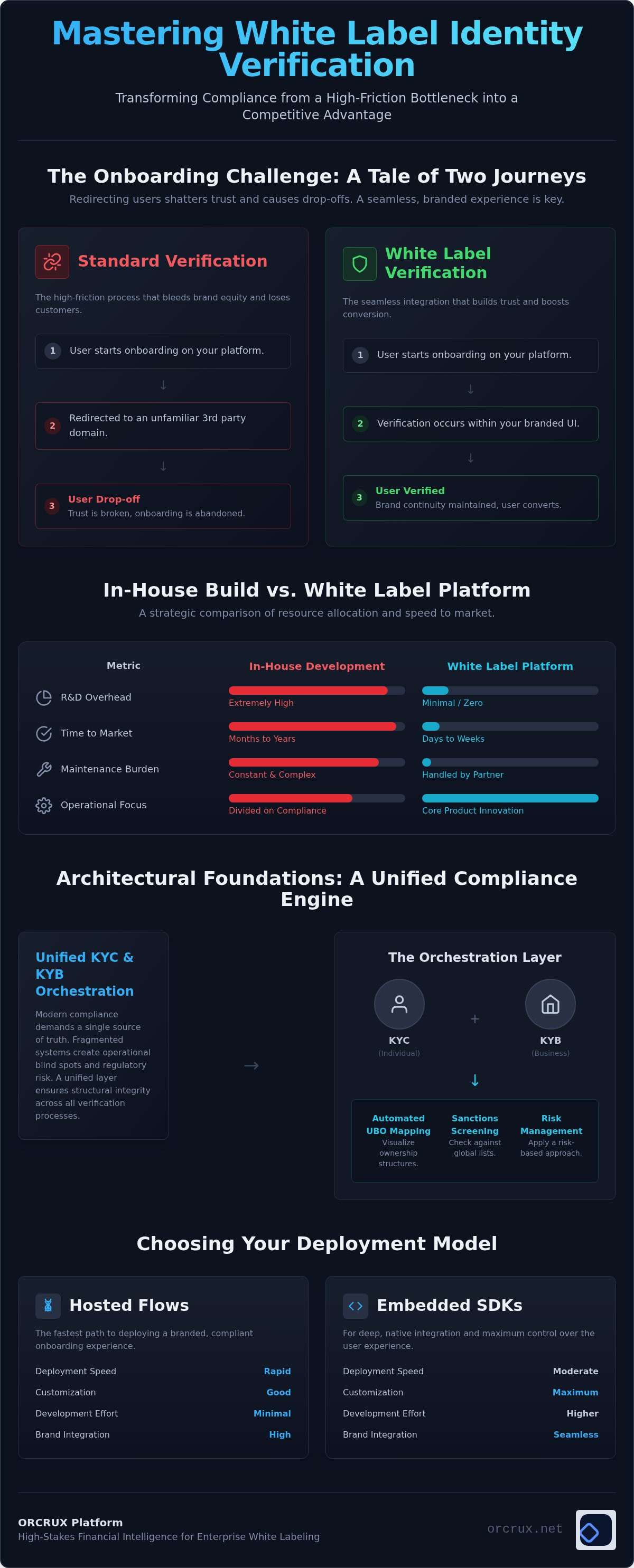
Enterprises face a distinct "Trust Paradox": users demand rigorous security but abandon platforms at the first sign of friction. When a verification flow redirects to an external third-party domain, it shatters the user's sense of security. This referral model creates a trust gap that often leads to drop-offs. Native, branded flows solve this by keeping the user within your trusted environment, ensuring that the heavy weight of professional responsibility is felt but never seen as a burden.
Removing Chaos from Customer Onboarding
Fragmented branding during sensitive data entry is a primary driver of onboarding failure. If the typography, color palette, or URL suddenly changes, high-value users question the legitimacy of the request. White-labeling is the structural integration of verification into a brand ecosystem. By maintaining a consistent UI, you provide a sense of order and control. This composed assurance reduces the cognitive load on the user. It turns a regulatory hurdle into a seamless milestone. Consistent visual cues signal that the platform is a stabilizing force, which is critical during the high-pressure environment of financial onboarding.
Cost-Efficiency vs. In-House Development
Building a proprietary stack to connect with global registries and update sanctions lists in real-time is an immense R&D burden. The maintenance of these connections requires constant engineering oversight and a deep understanding of evolving AML mandates. Leveraging a white label deployment through the ORCRUX Platform offers a "Compliance-as-a-Service" model that facilitates rapid market entry. It's about strategic partnership rather than a mere vendor-client transaction. You gain several key advantages:
- Reduced R&D overhead: Avoid the high cost of building and maintaining complex registry integrations.
- Scalable architecture: Use the ORCRUX API to handle high-volume onboarding without performance degradation.
- Operational focus: Your team focuses on core product innovation while the platform handles data integrity.
Implementing white label identity verification allows you to leverage the expertise of a seasoned veteran while retaining full ownership of the user journey. This approach ensures structural integrity across your entire ecosystem, positioning your service as a reliable leader in a high-stakes environment.
Architectural Foundations: KYC, KYB, and AML Integration
Success in white label identity verification requires more than a themed interface. It demands a unified orchestration layer that bridges the gap between individual (KYC) and corporate (KYB) verification. Modern enterprises cannot afford to silo these processes. A fragmented approach creates operational blind spots and regulatory risk. By establishing a single source of truth, you ensure structural permanence across all verification logs. This architectural integrity is essential for meeting the Customer Identification Program (CIP) rule requirements while maintaining a seamless brand experience.
Unified KYC and KYB Orchestration
Verifying complex corporate structures under a white-label banner is a significant technical challenge. It involves more than just confirming a business license; it requires identifying the human element behind the entity. Automated UBO mapping is critical here. It allows you to visualize and verify layers of ownership without manual intervention. This automation brings order to compliance chaos. It ensures that every stakeholder with significant control is screened against your risk-based approach. Automating the discovery of significant control ensures that your white label identity verification flow remains efficient even during complex KYB sessions. You can explore how these components fit together via the ORCRUX Platform.
High-Fidelity AML and Sanctions Screening
Real-time financial intelligence acts as a stabilizing force in high-pressure environments. When your system connects to global watchlists, it must do so with absolute precision. High-fidelity screening includes real-time checks for Politically Exposed Persons (PEPs) and adverse media. These checks must occur within the user flow without breaking the native UI. If a potential match occurs, the system should handle the resolution with disciplined transparency. Data integrity is paramount. Every screening result and decision must be recorded in a tamper-proof log. This creates a foundation of accountability. It ensures that your brand is protected by a unified, all-encompassing system rather than a collection of disparate tools. Steady authority in compliance is built on this level of technical rigor.
Evaluating Deployment Models: Hosted Flows vs. Embedded SDKs
Selecting the delivery mechanism for white label identity verification is a foundational architectural decision. It dictates the balance between speed of deployment and absolute control over the user journey. For many enterprises, the Hosted Page model offers the most efficient path to market. By utilizing a branded subdomain, you maintain visual continuity while the platform handles the heavy lifting of security and data integrity. It's a pragmatic choice for web-based ecosystems where stability is paramount and rapid scaling is a priority.
Conversely, organizations that demand total sovereignty over their logic choose an API-first strategy. This approach allows you to build bespoke verification waterfalls based on your specific risk-based KYC mandates. You aren't just adopting a tool; you're embedding a compliance engine into your product's DNA. This level of integration ensures that the platform acts as a stabilizing force, providing order and control even in high-pressure financial environments. Maintaining a "Calm Commander" persona requires these technical transitions to be invisible to the end user.
The SDK Advantage for Mobile-First Onboarding
Mobile applications require a specific level of technical rigor to ensure high-performance face authentication. The SDK approach provides a native app feel that is essential for maintaining user trust during biometric verification. SDKs handle device-level fraud signals in real-time by leveraging hardware-specific data that web browsers simply cannot access. This creates a high-fidelity environment for liveness detection and identity proofing. While the integration weight is higher than a hosted flow, the result is a frictionless experience that minimizes onboarding drop-off. It's about balancing technical performance with the composed assurance your users expect from a premium service.
Full API Integration for Custom Logic
When pre-built UI components don't align with your product's unique architecture, the ORCRUX API provides the necessary flexibility. This model is for organizations that want to design their own verification logic from the ground up. Financial intelligence APIs power these bespoke engines, allowing you to trigger different verification steps based on the user's risk profile or geographic location. You choose the API over pre-built components when the onboarding journey is non-linear or highly specialized. This strategic partnership approach ensures that your compliance stack is as innovative as the rest of your platform. It reflects a philosophy of careful deliberation and technical accuracy, ensuring that every verification log contributes to the structural permanence of your records.
Implementation Roadmap: Deploying Your Branded Verification Flow
Deploying white label identity verification requires a disciplined, top-down strategy. It isn't a cosmetic task but a methodical integration of brand values and regulatory requirements. Moving from a fragmented onboarding process to a unified ecosystem demands careful deliberation. This roadmap ensures that your deployment maintains structural integrity while scaling to meet enterprise demands.
- Step 1: Define the Risk-Based Approach (RBA). Map out specific data points required for your jurisdiction and user profile. This foundation dictates the logic of your verification waterfall.
- Step 2: Brand Asset Configuration. Move beyond logos. Configure DNS settings, typography, and color palettes to ensure the environment feels native.
- Step 3: Technical Integration. Provision API keys and initialize the ORCRUX API within your development environment. Establish the connection between your backend and the orchestration layer.
- Step 4: User Acceptance Testing (UAT). Conduct rigorous testing to identify UX friction and ensure regulatory alignment. This phase must include both individual KYC and complex KYB scenarios.
- Step 5: Go-Live and Monitoring. Transition to the production environment. Establish continuous monitoring of financial intelligence signals to maintain holistic oversight.
Configuring the Visual and Narrative Identity
A truly branded experience extends to every micro-interaction. You must customize error messages and success notifications to match your brand's voice. If a verification failure occurs, the narrative should maintain a sense of composed assurance rather than triggering security anxiety. This narrative consistency is a stabilizing force during high-stakes data entry. On the technical side, setting up custom domains and TLS auto-provisioning is non-negotiable. It ensures that the security of the connection is as visible as your brand's logo, reinforcing the trust your users place in your platform.
Testing for Regulatory Rigor
Regulatory accountability rests on the precision of your testing phase. You should perform stress tests on AML and sanctions screening within a sandbox environment before reaching production. This includes verifying that your white label identity verification reports meet the specific standards of local regulators. Audit trails are a critical component of this architecture. Every decision, from automated UBO mapping to manual reviews, must be recorded with structural permanence. These logs provide the transparency required for future audits. You can begin building this high-fidelity compliance stack today by exploring White Label Deployment options. Strategic partnership in this phase ensures that your platform is prepared for the weight of professional responsibility.
ORCRUX: High-Stakes Financial Intelligence for Enterprise White Labeling
The ORCRUX Platform serves as the definitive architecture for unified KYC and KYB orchestration. It provides the structural integrity required by enterprises to maintain absolute control over their compliance ecosystems. Unlike disparate tools that create operational silos, ORCRUX offers a holistic oversight model. This ensures every verification event contributes to a permanent, audit-ready record. By utilizing a white label identity verification deployment, organizations don't just outsource a task. They embed high-fidelity financial intelligence into their core infrastructure.
The ORCRUX API functions as the high-speed engine behind this deployment. It allows for the rapid processing of complex data sets, from automated UBO mapping to real-time sanctions screening. This technical rigor positions ORCRUX as a strategic partner rather than a mere software vendor. It's a relationship built on accountability and the shared weight of professional responsibility. The platform provides a sense of order and control, ensuring that your compliance stack is as premium and modern as your product.
Enterprise-Grade Reliability and Composed Assurance
Chaos in global business verification often stems from fragmented data sources and inconsistent vendor standards. ORCRUX removes this instability by providing a single-contract solution for KYC, KYB, and AML requirements. This unified approach simplifies vendor management. It ensures a consistent risk-based approach across all jurisdictions. The stability provided by ORCRUX’s global registry network ensures your verification flows remain performant even when accessing data from emerging markets. It's about providing peace of mind through a system that is disciplined, transparent, and deeply focused on security.
Next Steps: Securing Your Compliance Infrastructure
Transitioning from a legacy provider to a unified white-label ecosystem is a critical move for future-proofing your operations. Many existing systems lack the architectural flexibility to handle the evolving nature of financial risks. ORCRUX provides the framework to modernize your onboarding journey without disrupting your existing user experience. It allows you to scale your operations while maintaining the rigorous standards required by modern regulators. You gain a stabilizing force in a high-pressure environment.
Securing your brand's future requires a partner that understands the high stakes of financial compliance. You can take the first step toward architectural permanence by choosing a platform designed for the most demanding enterprise environments. Request a professional briefing on ORCRUX White Labeling to learn how our orchestration layer can stabilize your compliance infrastructure.
Securing Your Brand's Operational Future
Building a resilient compliance stack is a matter of structural integrity, not just visual alignment. Successful enterprises treat white label identity verification as a core architectural pillar rather than a cosmetic addition. By integrating unified KYC and KYB orchestration, you eliminate the friction that leads to user drop-off while maintaining absolute regulatory rigor. The transition from simple vendor relationships to strategic partnerships allows your organization to scale with composed assurance and professional discipline.
High-fidelity financial intelligence is the benchmark for modern marketplaces and fintechs. Implementing a system that offers holistic oversight ensures your brand remains a stabilizing force in an increasingly complex global market. You don't have to navigate the chaos of fragmented data or legacy silos alone. A unified ecosystem provides the order and control necessary for long-term growth and accountability.
Architect your compliance ecosystem with ORCRUX to gain enterprise-grade architectural integrity and advanced AML and sanctions screening. It's time to transform your onboarding journey into a seamless, high-performance extension of your brand DNA. Your path toward a more secure and professional compliance environment begins with a single, deliberate step toward technical excellence.
Frequently Asked Questions
What is white label identity verification and how does it work?
White label identity verification is an enterprise-grade compliance infrastructure that allows businesses to embed KYC and KYB processes directly into their own brand environment. It works by utilizing a backend orchestration layer to handle data integrity and screening while the user remains within your native UI. This ensures that the heavy weight of professional responsibility is felt through security, not through fragmented third-party redirects. It's a strategic tool for maintaining brand continuity.
Can I customize the KYC flow to include business verification (KYB)?
You can absolutely customize your verification flow to include Business Verification (KYB). The ORCRUX Platform provides a unified orchestration layer that bridges individual and corporate checks. This enables you to verify complex business structures and individual stakeholders within a single, branded experience. By integrating these processes, you achieve holistic oversight of your entire onboarding ecosystem. It removes the chaos often associated with siloing different verification types.
Is white-label KYC compliant with global AML and GDPR regulations?
White-label solutions are designed to meet global AML and sanctions screening requirements. The platform provides the technical rigor necessary to comply with GDPR and other data privacy mandates. High-fidelity financial intelligence ensures that your branded flow remains as secure as any third-party interface. It's important to remember that the underlying provider handles the regulatory heavy lifting while your brand maintains the user-facing relationship and trust.
What is the difference between a co-branded and a fully white-labeled solution?
Co-branded solutions display the logos of both the service provider and the client. A fully white-labeled solution removes all third-party identifiers to ensure a seamless brand experience. This includes using custom domains and tailored visual assets like typography and messaging. Most enterprises prefer full white-labeling to prevent the Trust Paradox where users drop off after being redirected to an unfamiliar domain during sensitive data entry.
How long does it typically take to deploy a white-label identity verification flow?
Deployment timelines vary based on the chosen integration model. A hosted page deployment can often be completed in a few business days. More complex integrations using the ORCRUX API or embedded SDKs may take several weeks. These timelines depend on your specific risk-based approach and the depth of custom logic required. A methodical white label identity verification implementation ensures that your compliance infrastructure has the structural permanence needed for success.
Can I use my own domain for the verification hosted pages?
Using your own domain is a standard feature of a professional white-label deployment. You can configure custom DNS settings and TLS auto-provisioning to ensure the entire journey happens on your subdomain. This architectural integrity is vital for maintaining user trust. It prevents the security anxiety that occurs when a browser's address bar suddenly changes to a third-party vendor's URL during a high-stakes verification process.
How does white-labeling impact the user conversion rate?
Branded verification flows significantly improve user conversion rates by reducing onboarding friction. When the UI remains consistent, users feel a sense of composed assurance. They are less likely to abandon the process because the environment feels safe and native to your product. By resolving the trust gap associated with third-party redirects, you transform compliance from a potential bottleneck into a stabilizing force for your user growth.
Does ORCRUX provide automated UBO mapping in its white-label platform?
Automated UBO mapping is a foundational capability of the ORCRUX Platform. It identifies and verifies individuals with significant control over a business entity during the KYB process. This feature brings order to the chaos of complex corporate hierarchies. In a white-label environment, this mapping happens behind the scenes. It allows your brand to deliver high-fidelity financial intelligence without requiring manual intervention or breaking the seamless user experience.
